
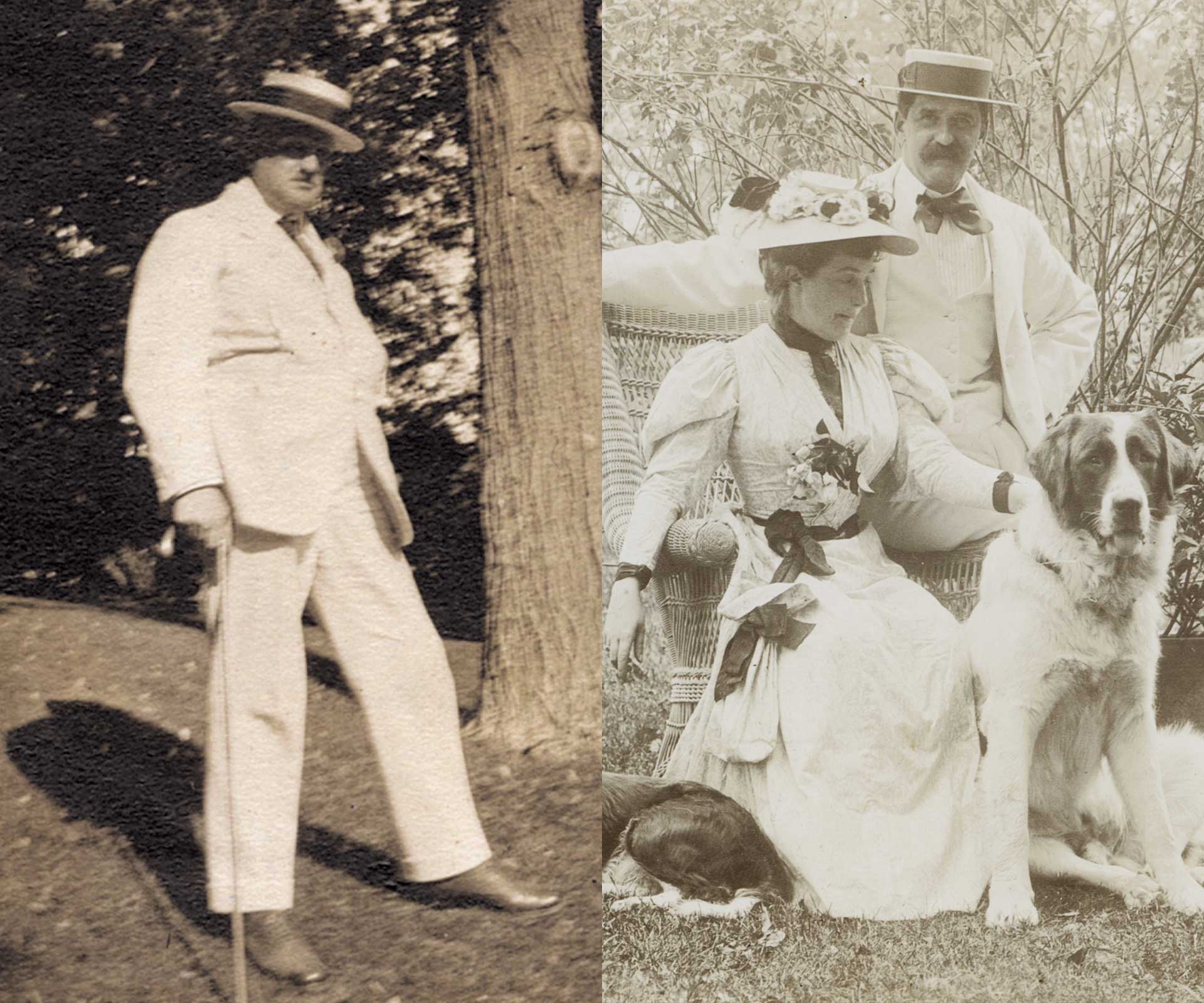
Excerpts from: Some Recollections of the Visit of Sibelius to America in 1914
By Carl Stoeckel
PART II NORFOLK
The Grand Central station was another of the great sights which astonished him. As we entered it he remarked, “What a place for a concert, if one could have an orchestra of two or three hundred pieces!” When we reached the Housatonic river he admired the beauty of its winds, specially between New Milford and Canaan, and was delighted with its Indian name, which he repeated many times so as to memorize it. We reached Norfolk at 7:20, in the evening, were met by our horses, which excited more admiration from Sibelius who said, “Life and action and color give one a feeling of exhilaration which the automobile entirely lacks.”
On coming into the house and looking about he said, “This house is truly the home of poetry.” He was introduced to all of the help with whom he became a great favorite. His room was what is called in our house “the old blue room,” used as a library during the lifetime of the original builder of the house, Joseph Battell, in 1798, and converted by his children later into a bedroom.
We then had supper and afterwards went to the Shed to inspect it, as it had been lighted up for this purpose. He was pleased with the entire Shed and inquired which side he was to come in on. I said on the men’s side [at that time, the right side], at which he was again pleased, remarking that he always felt better to come in from that side. We walked back to the house again, had some conversation and then retired.
[The next day Sibelius went to the barber for a shave, met the daughters of Yale Professor Horatio Parker, visited the home of Mr. Cater, and took a short walk around Hillhurst square reaching home about six o’clock for supper.]
Soon afterwards the train began to arrive with the chorus members for the second joint rehearsal in the Shed. He was greatly interested in watching the 525 men and women of the chorus who passed the house on the way to the Shed and remarked frequently what fine looking, well-built people they were. After they were all assembled on the stage, Sibelius was quietly conducted, as yet unrecognized by anyone, into the auditorium. Although I urged him several times to return to the house and not remain for the conclusion of the three-hour rehearsal, he preferred to stay.
The next day, Saturday, we had a long automobile drive through Stockbridge, Lenox, etc., returning via the undermountain road, through Salisbury, where we had tea at Mr. Perry’s Inn. Sibelius was pleased with this old house and praised the tea. We reached Norfolk in time for supper after which some friends called who were interested in listening to the composer’s impressions of Litchfield County and Berkshire County scenery. He was most enthusiastic over it and especially over the renewed glimpses of the Housatonic river. I wrote for him the old Indian spelling of this name “Ousatonic” and he was greatly pleased with the euphony of the word and repeated it frequently to himself many times during his visit at Norfolk.
The next day, Sunday, we inquired whether he would like to go to church. He remarked that his family religion was of the Lutheran faith. As a matter of observation, he said he would like to attend the services, so he went to the Norfolk Congregational church. Sibelius entered one of the empty pews, sat there for a few moments and then was requested to leave it as it belonged to the reserved section. This was an unfortunate experience for a foreigner as it gave him an impression that aristocratic tendencies prevailed in the seating of the congregation. He was taken to another pew and returned home rather tired, as he said that the preacher spoke so fast he could not understand a word. He was interested in the music and spoke of the old-fashioned New England hymns. He knew their history, as he knew about almost everything.
We brewed a new drink for dinner, consisting of claret and ginger ale mixed with equal portions, two cut up lemons, a dash of sugar and a handful of mint. The colors in this mixture were regarded by Sibelius with great satisfaction, but he did not drink of it, preferring his usual bottle of soda water.
In the afternoon we went on an auto ride to Litchfield as our guest knew that it was the birthplace of a number of celebrities. He asked to see the house in which Harriet Beecher Stowe and Henry Ward Beecher were born. Also, the building of the first law school in the United States. He admired the quaint old street and said he understood quite well why the Frenchmen of the revolutionary period sent their sons to this refined old town for education in the English language. He also asked about the birthplace of John Brown in the neighboring town of Torrington. We came home by way of Torrington and Winsted in order to see Highland Lake as Sibelius was always anxious to see any lake or mountain scenery; at Litchfield he had asked for a short detour that we might see the lake there.
In the evening my wife sang some negro melodies to him which he greatly appreciated, remarking that it was music of the soil.
The next morning, he spent by himself, walking about town and observing the preparations for the dress rehearsal that evening. The orchestra and soloists arrived at 1 :20 and Sibelius went with my wife to the Robbins House to receive the soloists and there met Madame Gluck, Miss Braslau, Mr. Witherspoon and Mr. and Mrs. Mees, as well as Mrs. Braslau. They all went out on the lawn and several snapshots of the composer were made with the different soloists and composers. In this connection it may be said that the composer with his usual modesty had not brought any photographs of his own with him and personally was averse to having any taken but stood as a matter of accommodation to his acquaintances. He was always good-natured about this as he was about signing scores and photographs which were brought to him by the dozen. He made it a point as much as possible to vary the inscriptions which he wrote on such scores and music.
In the afternoon he rested a while and then took a walk, returning for supper at six o’clock. He then sat on the back porch and watched the chorus coming in, this time remarking that he had observed many pretty girls. The orchestra also strolled in one by one, all greeting him, as they of course knew him from their meeting at the New York rehearsals. Later we strolled down to the Shed and listened to the rehearsal of Arminius and the Messiah. He did not say much about Bruch’s work, but from his remarks, I judged that he did not have a high opinion of it as a musical composition, but thought that it was an excellent work for a chorus to sing as a contrast to the Messiah. Of the Messiah he spoke highly and said he admired the Handel work more each year. He sauntered about the grounds after the rehearsal for some time, much pleased with the many torches which were arranged in the ledge and on the lawn.
On the next morning, which was Tuesday, June 2, he had an orchestral rehearsal in the Shed, running through the new work again, Pohjola’s Daughter, and part of the King Christian Suite. At one, Miss Laura Tappen arrived, a cellist, from New York. Sibelius inquired about her work and then she asked him what compositions he had written for the cello. He mentioned them all and advised her not to try “Malinconia,” which he remarked, with an indulgent smile, should not be played by young ladies, but only by “old roues.” There was a good deal of merriment over this and during the rest of his stay this composition was always spoken of as “the roue work.”
In the afternoon there was a short automobile ride and in the evening at 7:30, I conducted Sibelius to the Shed to his reserved seat.
People by this time, and especially the chorus, knew who he was and he was received with applause by both chorus and orchestra, to which he apparently paid no attention. He was elegantly attired in a black evening suit, with opera hat, patent leather shoes, wearing in his button-hole the red ribbon of the Legion of Honor. He was the picture of style, with great distinction of bearing and manner. He enjoyed watching the audience of twenty-one hundred people and listening to their comment. After the concert was over, he retired at once to his room.
The next morning at 9: 30, Sibelius was on hand for another rehearsal of his works which, for this rehearsal, were Finlandia, Valse Triste and the Swan of Tuonela. He was, as usual, very particular in taking each piece section by section and was especially careful of the effects in the brass instruments which he wanted round, polished and powerful, without the explosive effects.
After the rehearsal, at my request he came on the porch of the Music Shed and was photographed with Madame Powell, who was the first in America to perform his violin concerto, and Henry E. Krehbiel [Music critic of the New York Tribune], who had previously secured from him an autograph with the opening lines of his new pantomime opera. After this he attended the lawn party of the orchestra from 12 to one o’clock, conversing with the men and with Hadley, the American composer, who was also present, and in honor of the many toasts offered to him, drank one small glass of Rhine wine. Several of the men took photographs of him and he was entirely affable in responding to their requests. In fact, during his entire visit, I never saw him rude or impatient with anyone, and he had to reply to a great many preposterous questions.
There was a jolly party at lunch and Sibelius was in fine fettle, telling a number of stories, all of a funny nature and anxious to hear any stories which the guests might have to tell in return. After lunch Sibelius, the Parkers and Miss Tappen went for a drive through Lovers Lane. After his return from the drive he retired to his room, remaining there until time for the evening concert, when he came downstairs faultlessly attired as usual, in his dress suit and opera high hat.
He walked with me to the Shed, talking of the pleasure which he anticipated from hearing the Messiah of Handel’s. He entered his seat so quietly that no one knew of his presence until he had been seated about 10 minutes, then the chorus applauded but he took no notice of this. He was probably the most intent and interested auditor in the building and after the close of the concert remarked that it was the most beautiful performance of the Messiah which he had ever heard anywhere.
After the close of the concert, he walked with me up to the house, being introduced to several of the audience on the way. He was especially pleased with some children who understood German a little and reminded him of his children in Finland. There was a supper party at the house of 25 people in honor of Henry Hadley, and Sibelius much enjoyed talking over the concert and Hadley’s composition with the various guests.
SOME RECOLLECTIONS OF THE VISIT OF SIBELIUS TO AMERICA IN 1914
Author(s): Carl Stoeckel and Jean Sibelius
Source: Scandinavian Studies , WINTER, 1971, Vol. 43, No. 1 (WINTER, 1971), pp. 53-88
Published by: University of Illinois Press on behalf of the Society for the Advancement of Scandinavian StudyStable