
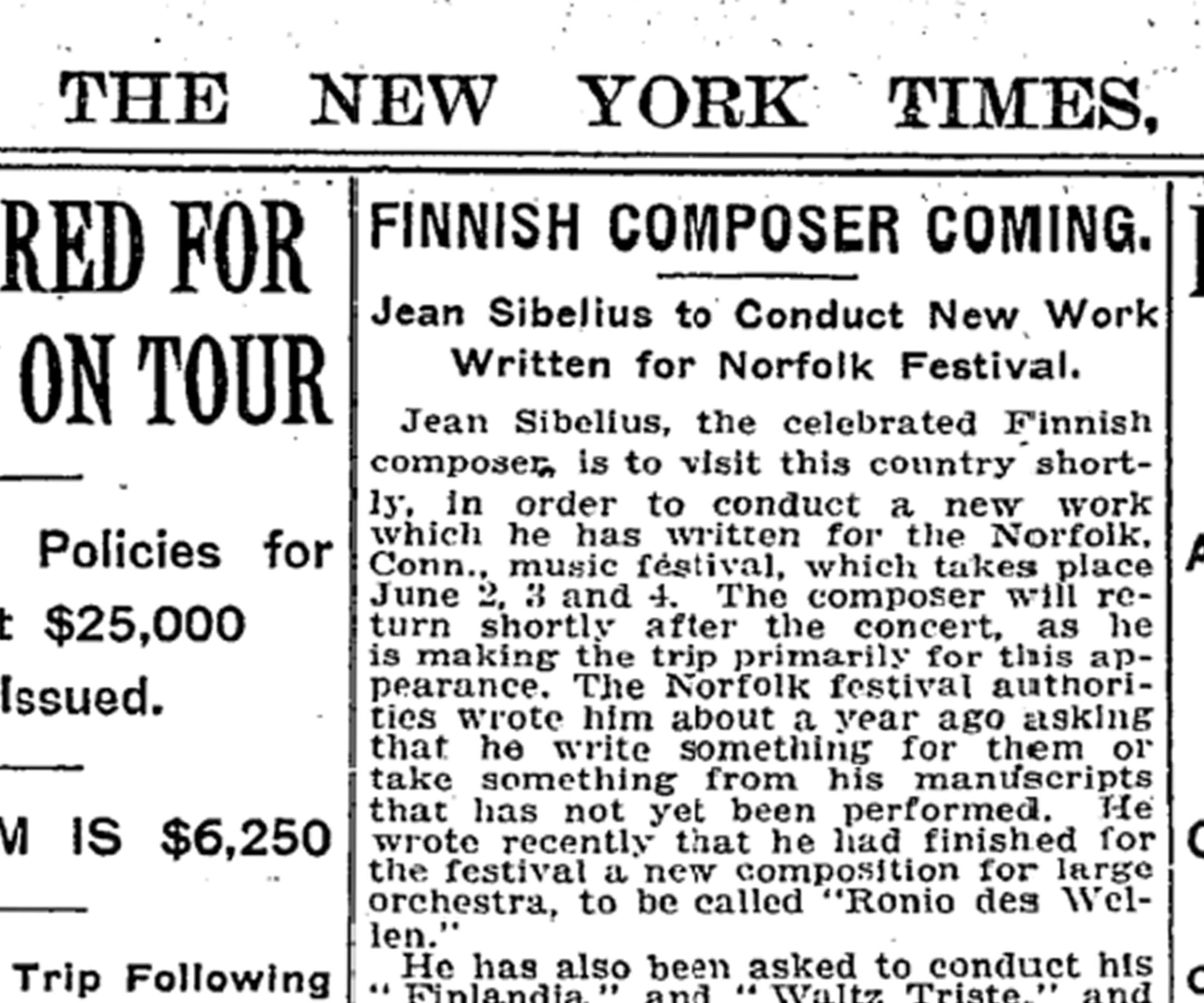
Excerpts from: Some Recollections of the Visit of Sibelius to America in 1914
By Carl Stoeckel
PART III SIBELIUS’ MUSIC SHED DEBUT
The next morning he arose early as usual, had his breakfast in his room and then wandered about the grounds and at 9:30 was ready for the rehearsal in the Shed, which consisted entirely of his new works. After the rehearsal he again attended the lawn party, more photographs were taken of Sibelius and a number of orchestral scores of his works were handed to him for signature. He complied with each such request with the utmost good nature. In the afternoon he went with me for an auto drive, returning in ample time to dress for the concert.
As we went to the Shed he remarked that he was feeling pretty nervous but that after he had been on the stand for five minutes it would disappear. Audience, orchestra and chorus all rose to their feet to receive him. The orchestra playing an effective “Tusch” as he entered. He bowed on all sides and then raised his baton for the first measures of Pohjola’s Daughter. Then commenced an hour of the most tense and interested attention that I have ever seen on the part of an audience. With each selection the enthusiasm grew. As a conductor Sibelius was graceful and at the same time forceful.
Everyone who was fortunate enough to be in the audience agreed that it was the musical event of their lives, and after the performance of the last number there was an ovation to the composer which I have never seen equaled anywhere, the entire audience rose to their feet and shouted with enthusiasm, and probably the calmest man in the whole audience was the composer himself; he bowed repeatedly with that distinction of manner which was so typical of him, and carefully arranged the composer’s wreath which had been handed to him on the railing of the conductor’s stand. It was tied with the colors of Finland, the flag of which had been arranged at the foot of the stand with that of the United States. Finally, Sibelius walked off of the stage but had to come back many times.
At the conclusion of each piece, he called up any orchestral musician who had played a solo, if there was one in such numbers, to share the applause with him, thus in the “Musette” of “King Christian Suite” he signaled to the clarinet and flute players to arise. This seemed a new feature to the men, and they did not understand at first what the composer wished, so he whispered to the cello players who passed the word on to the other men and then they stood up. The audience quickly recognized the fairness and courtesy of the composer and redoubled their applause.
As calm as Sibelius had appeared on the stage, after his part was over, he came up stairs and sank into a chair in one of the dressing rooms and was very much overcome. My wife asked him to sit up in front with us but he said he preferred to be all alone for a while and he sat by himself in the darkest corner of the dressing room where no one could see him.
He then came to the front in the window at the side of the stage and stood with Madame Gluck while the chorus, orchestra and audience performed the national anthem of Finland, by Pacius. He was greatly moved at this second demonstration in his honor and grasped my hand, saying, “Finland thanks you and your wife. I regard the singing of this anthem as an honor not to me but to my native land.”
He then rode in a carriage to our house in order to be there on time. He was the first of the guests of the evening to reach the house and made a touching speech to my wife who had returned before the conclusion of the concert in order to receive the guests.
Soon after the entire company went to the supper which was given on this evening in honor of Sibelius. A number of speeches were made in his honor, among them remarks by Chadwick [Director of the New England Conservatoryof Music] and Parker. Sibelius spoke very briefly with much feeling of the incidents connected with his visit, speaking not only of the musical side, but also of the social phases. All his responsibility was over, and he regarded his part of the program as having success with the audience and said that he would send a cablegram to his wife in Finland the next morning.
SOME RECOLLECTIONS OF THE VISIT OF SIBELIUS TO AMERICA IN 1914
Author(s): Carl Stoeckel and Jean Sibelius
Source: Scandinavian Studies , WINTER, 1971, Vol. 43, No. 1 (WINTER, 1971), pp. 53-88
Published by: University of Illinois Press on behalf of the Society for the Advancement of Scandinavian StudyStable