
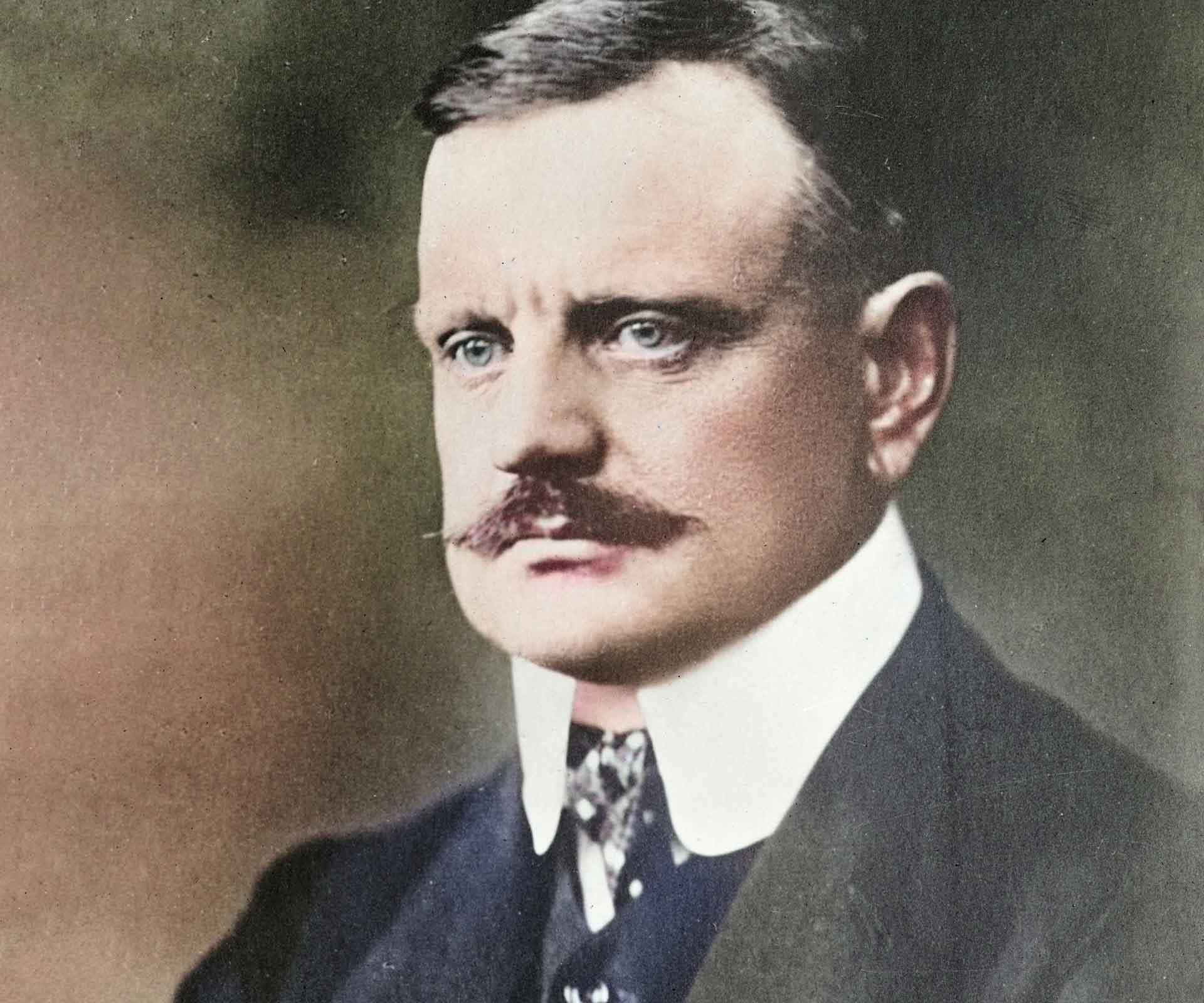
Excerpts from: Some Recollections of the Visit of Sibelius to America in 1914
By Carl Stoeckel
PART I Arriving In New York
My first impressions and also my last of Sibelius as a man and artist are those of the two principal attributes of greatness: simplicity and modesty.
When I went to the dock to meet him I had great difficulty in finding the composer, although I had a good description of him and an excellent photograph. I was on the point of leaving the dock when off in the distance I saw a porter with a trunk, a suitcase and a hat case. I thought I would take one more chance… a gentleman came down the gangplank, fully an hour after all the other passengers had left the boat. I had pictured Sibelius as having dark hair and moustache, but in the distance at least, this did not answer my preconceived notion of his appearance, as he was distinctly blond. As he came toward his trunk, I recognized his features as being those of our elusive composer. I think he had quietly planned to evade reporters and take his property from the dock without fuss or feathers. This, however, was not permitted to be as he was soon surrounded by several reporters and musical people.
We disentangled ourselves from the group of reporters and took an electric cab for the Essex, bringing the baggage with us on the front seat. Sibelius was enormously interested in the high buildings which we passed and remarked that he had never been in a building over six stories in height. I told him he would have a new experience that very evening as his apartment at the Essex would be on the tenth floor. He was astonished and wanted to know how the people slept at such a height. When we reached the Essex we came up to our apartment and the composer was presented to my wife [Ellen Battell Stoeckel]. He took her hand and kissed it three times with reverence and formality as well as with grace.
He was shown to his apartment and was delighted with the apparatus for taking shower baths which was attached to his bedroom. This is a peculiar fixture which can be used either as a shower bath or a needle bath, and Sibelius was as much delighted with it as a child with a new toy. He was also astonished to find a bathroom with every bedroom in the apartment. He said that in Finland at his villa near Helsingfors, the bathhouse was separate from the house and the water had to be heated at a good deal of trouble besides the bother of walking to and from the bathhouse.
We went to Delmonicos for supper, knowing that this place had some admirable arrangements for securing fresh caviar. We ordered some of this delicacy, which pleased Sibelius, who was good enough to say that it was finer than any that could be obtained in Russia at the hotels there. We had some broiled salmon as the composer was fond of fish in any form, followed by roasted guinea hen, with Delmonico potatoes, and for the composer lettuce and tomato salad. He did not care for ices of any kind and asked for some cheese for dessert and the strongest coffee which could be made. He was extremely abstemious, drinking nothing but bottled waters.
Before going to the rehearsal [at Carnegie Hall] we went to Rogers Peet Company, where the composer changed his heavy blue serge suit for immaculate white flannels. Some friends in Finland had told him that American summers were very cold so he had brought only heavy garments in his wardrobe. He was very particular about the fit of his new white suit and when he finally found what was wanted, it proved as fine a fit as any Fifth Avenue tailor could provide. He also bought an American straw hat and when his turn came to rehearse the orchestra, he walked on to the stage, hat in hand, mounted the conductor’s stand, and in response to the applause from the orchestra, bowed first to the left, then to the center and then to the right. He was an imposing figure as he stood all in white with his baton lifted for the first beat.
Although the rehearsals were supposed to be private, there were a score of newspaper men and reporters of musical papers present. Some of them tried to pump Sibelius as to the meaning of certain passages in his music, but he would not say anything definite, answering always that everyone must use his own imagination for his works.
He said he liked every man in the orchestra but one. He felt sure that this man was not doing his duty and wanted to know if he could be discharged. I explained to him that the orchestra were all working under Union rules and could not be discharged under such rules. He then remarked that he was going to keep his eye on this man and see that he did his duty. I suppose that his tactics were successful as after the concerts were all over he remarked that this particular man seemed to know that he was being watched and braced up in a very satisfactory manner.
The next morning, he made some other changes on his new score [Aalottaret subsequently published as the Oceanides], remarking that since he had crossed the ocean, he had learned more about it than from gazing at it from the shore of Helsingfors. At noon he said his score was completed and in the afternoon, we took the train for Norfolk.
SOME RECOLLECTIONS OF THE VISIT OF SIBELIUS TO AMERICA IN 1914
Author(s): Carl Stoeckel and Jean Sibelius
Source: Scandinavian Studies , WINTER, 1971, Vol. 43, No. 1 (WINTER, 1971), pp. 53-88
Published by: University of Illinois Press on behalf of the Society for the Advancement of Scandinavian StudyStable