
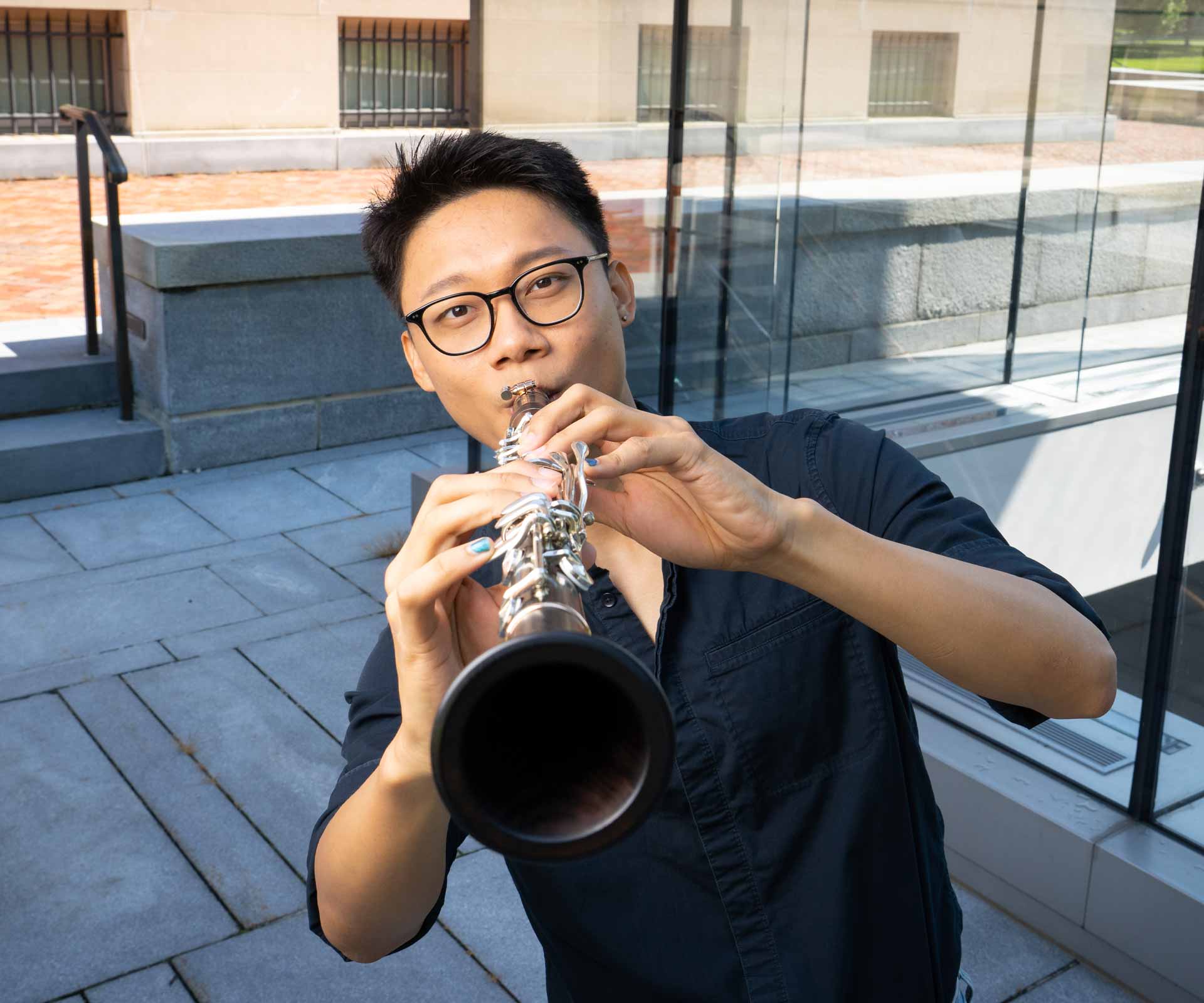
Taiwanese clarinetist Chao-Chih George Chen has won top prizes at the Taiwan National Music Competition and the Buffet Crampon Asia Pacific Clarinet Competition. He has performed as a soloist with several Taiwanese orchestras and with the Stony Brook Symphony Orchestra under the direction of Anthony Parnther. He holds a Doctor of Musical Arts degree from Stony Brook University, where he studied with Alan Kay, and currently teaches at the 92nd Street Y School of Music and the Harmony Program. In addition, Chen is interested in the psychology of human behavior, mindfulness, and playing the saxophone.
When not playing music, what are you up to?
I’m usually following my curiosity. Sometimes that means reading a book. Sometimes it’s exploring NYC with friends, trying a new coffee shop, practicing yoga, or falling down a rabbit hole on a topic I know nothing about. I get fascinated easily. The challenge is that my curiosity doesn’t always know when to stop.
For example, I might pick up a book I’m excited about. They’re usually nonfiction books from my ever-growing reading list, books on psychology, mindfulness, education, or human performance. Once I start reading, I disappear into the rabbit hole of words and lose all sense of time.
Then suddenly—
Oh God. What time is it? How did it get this late already? I still have three chapters to finish. No, four. And what about that other book? On becoming a Person? Didn’t I say I was going to start that tonight? Okay. Relax… You’re doing it again… You always think you can read more than you actually can. Just adjust the plan. But if I don’t finish this chapter, it’ll bother me… And there are still so many things I don’t know. So many versions of myself I haven’t become yet… Maybe I should take a break… Why not take a look at social media? One post. One reel. One more… AHHHHH!!!!!… Okay, fine… Back to the book… But now I’m too restless to focus… Maybe, I should just… STOP! I tell myself.
When I’m not playing music, I’m often taking care of my inner Asian mom-my monkey mind. She’s compassionate. She’s always trying to solve problems, protect me, and make sure I don’t miss an opportunity. But sometimes she works a little too hard. I’ve found that the best way to help her relax isn’t to argue with her or follow every thought she creates. It’s to stay in the present moment and gently tell her: It’s all good.
Some audience members are hesitant to explore new music, preferring classics from the romantic, classical, or baroque eras. Is there a difference in how you would recommend they approach new music? What would you share to encourage exploration? Is there a work or composer from recent years that you would recommend as an introduction?
First of all, you don’t need to explore new music if you don’t want to. I’ve been a student for most of my life, and there was a point when I felt overwhelmed because it seemed like there was an endless amount of things to learn. Sometimes all I want is a peaceful life!
However, if you’re someone who feels you’ve had enough of older repertoire or thinks you’ve developed your own musical taste, there are many other options to explore. It’s like going to a gelato shop: besides pistachio or chocolate, there are flavors like durian (which I love!) or even cucumber.
Personally, I enjoy trying new music. I’ve spent most of my life playing traditional repertoire, and I feel that I’ve developed my own artistic judgment and sense of aesthetics. So why not try something new?
On the other hand, if you’re new to Western classical music, starting with contemporary music can be just as fascinating. My parents mostly listened to Taiwanese pop songs from the 1950s and 1960s, so for them, even Beethoven or Chopin was once “new music.” Since most of their experience with Western classical music has come through me, and I perform a lot of contemporary repertoire, they actually know composers like Elliott Carter and Robert Muczynski better than many composers from earlier eras. And they like it!
As for where to start, I would encourage everyone to join us for the New Music Recital at Norfolk on July 3, 2026, at 7:30 p.m. in the Music Shed!
As an alum returning for a second year, would you share a favorite memory of Norfolk from last year?
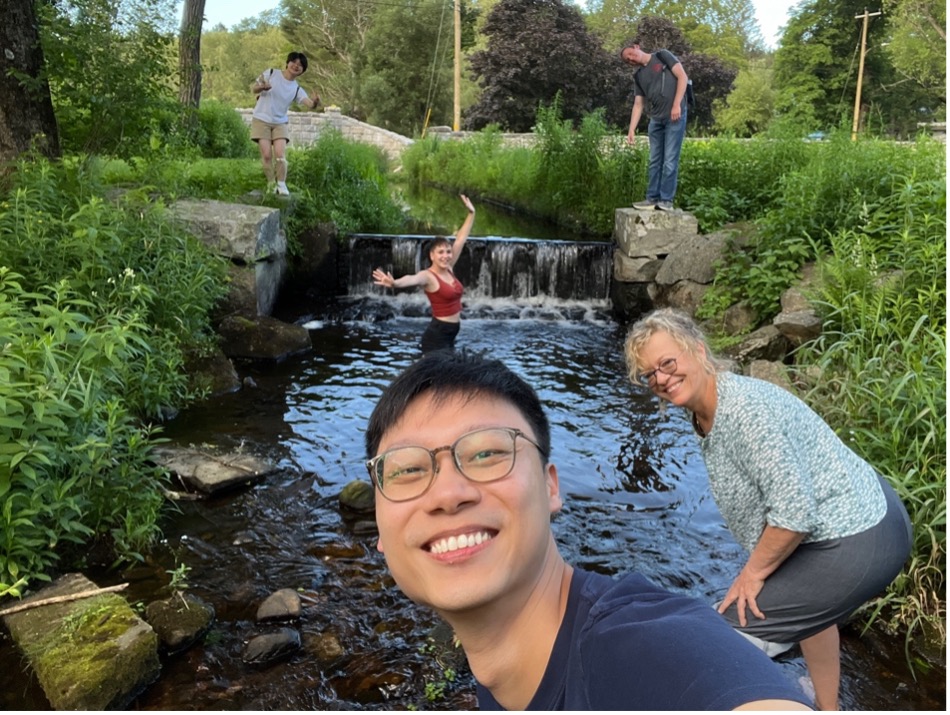
One of my favorite memories from Norfolk happened after an intense but deeply meaningful rehearsal. Instead of heading straight back to practice, we decided to simply enjoy the moment together. Some of us were playing frisbee. Jonah Cohen and Elias Valle were performing Steve Reich’s Clapping Music. Andrea Ábel was completely immersed in the water of the brook. Lisa Moore and I were slowly walking along the shoreline, while Leona Liu spent what felt like the entire evening deciding whether she wanted to step into the water or not. At one point, I paused and took in the whole scene, and I felt incredibly grateful to be surrounded by those people. Every one of them is a wonderful person, and I felt lucky to share that summer with them.
Aside from program pieces you are working on at Norfolk, is there a composer or work that you are focusing on? Would you share the work/composer and why?
I am preparing for several music festivals later this summer. Recently, I have been working on Martin Bresnick’s Mayn Rue Plats from Bitter Suite, and I just completed a recording project featuring Nirmali Fenn’s When Shadows Hold Their Breath and From Below. What follows is not necessarily an explanation from the composers’ perspectives, but rather my own experience as a listener and performer:
The sound world of Dr. Bresnick’s Mayn Rue Plats is rich with emotional depth. To me, the clarinet feels like a soul trapped within its own world, struggling to express something deeply important while fearing it may never be heard. The piano, meanwhile, serves as a compassionate listener, offering understanding and acceptance rather than resistance. The result is a work of profound beauty and emotional resonance.
Dr. Fenn’s When Shadows Hold Their Breath for clarinet and piano gives me the sensation of traveling through my subconscious. There is a scene in Demon Slayer where a demon enters a person’s subconscious world. The demon’s goal is to reach the boundary between the subconscious and the unconscious mind and destroy the person’s spiritual core. In When Shadows Hold Their Breath, I feel as though I am exploring those inner chambers myself, moving through different layers of consciousness, subconsciousness, and unconsciousness. What fascinates me is that the piece allows me to experience these spaces from multiple perspectives rather than a single point of view.
What excites me most about working with living composers is that I can participate in the creative conversation itself. Rather than interpreting history alone, I get to help shape it.
Do you find that your training and skills as a musician are helpful in the non-musical areas of your life?
Definitely. Besides learning to think critically and systematically, solve problems, and work collaboratively, a skill I have developed through music is striving for excellence without falling into perfectionism. That mindset shift has helped me relax a lot.
Like many musicians, I care deeply about my work and strive to achieve a high standard. Yet I noticed something frustrating: the performances I cared about the most often fell short of my expectations, while the ones I worried about less sometimes turned out better. For a long time, I struggled to understand why. Eventually, I realized that I was confusing caring with controlling. The more tightly I tried to control an outcome, the more restricted I became. When I learned to let go of the need to control and focus on the present moment, more possibilities emerged.
Today, I still prepare thoroughly and care deeply, but I try to approach challenges with curiosity rather than tension. I remind myself to strive for excellence, not perfection. That shift in mindset has improved not only my musicianship but also the way I approach life.
What are some of your long-term goals as a musician?
Besides performing as much as I can, one of my long-term goals as a musician is to share the stories behind the music that I find meaningful and inspiring. What I care deeply about is living a peaceful life. I believe our feelings are always real, but our thoughts are not always true. Through reading, reflection, and life experience, I try to better understand myself and the world around me. Then, through concerts and educational programs, I hope to share what I have learned with others.
This is a long-term goal because it requires both study and lived experience. The more I learn about music, people, and life, the more I feel I have something meaningful to share.