
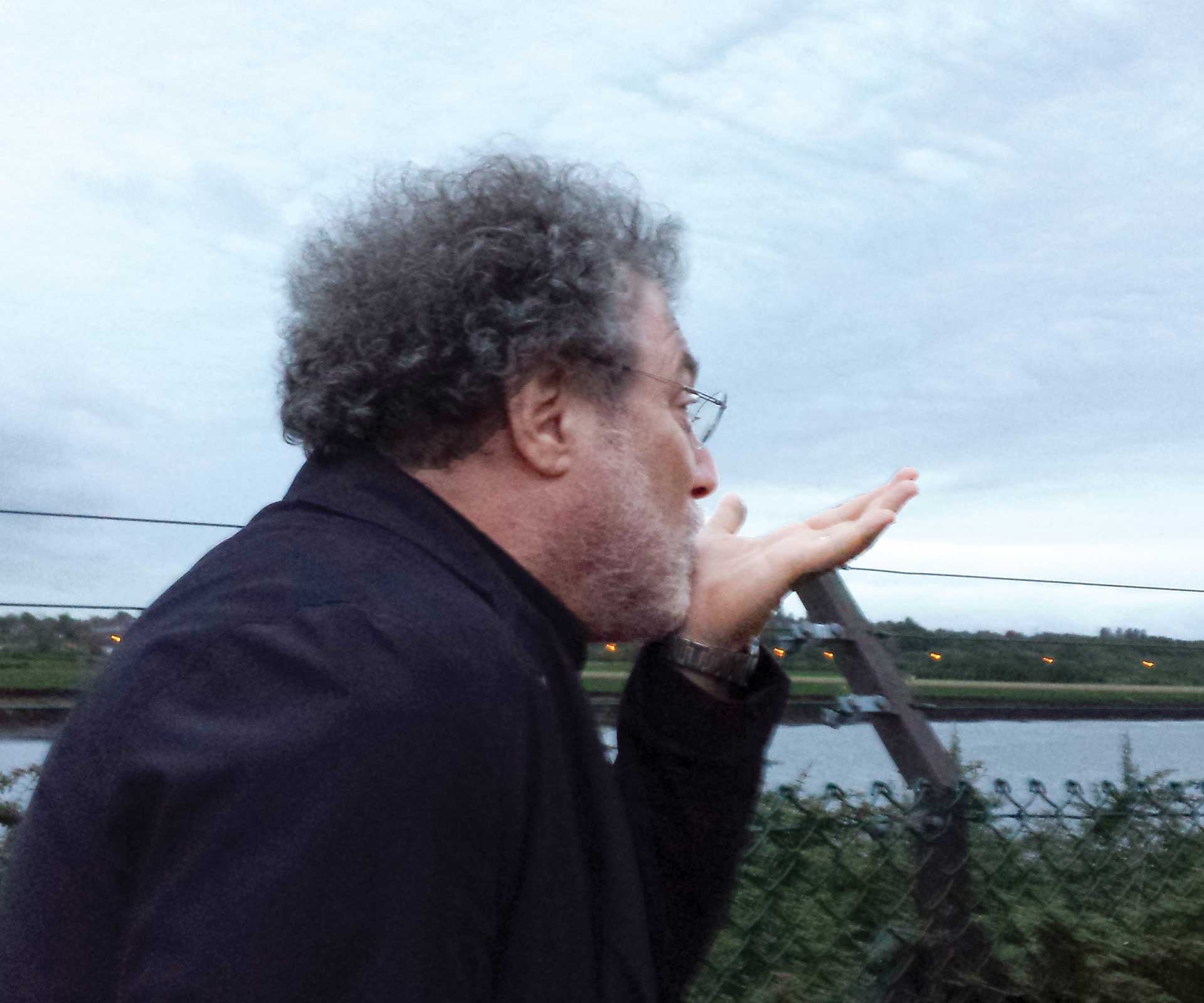
Martin Bresnick’s compositions, from opera, chamber and symphonic music to film scores and computer music, are performed throughout the world. Bresnick delights in reconciling the seemingly irreconcilable, bringing together repetitive gestures derived from minimalism with a harmonic palette that encompasses both highly chromatic sounds and more open, consonant harmonies and a raw power reminiscent of rock. At times his musical ideas spring from hardscrabble sources, often with a very real political import. But his compositions never descend into agitprop; one gains their meaning by the way the music itself unfolds, and always on its own terms. Recognized as an influential teacher of composition, Bresnick’s critical encouragement has inspired students from every part of the globe and of virtually every musical inclination.
What is a favorite non-musical pastime? What do you do to recharge?
My wife Lisa Moore and I are avid tennis players. She has been playing since she was a kid and she taught me (almost) everything I know.
As not only an acclaimed composer, but also an influential teacher of composition, is there a particular piece of advice or insight that you share with young composers as they begin their careers?
Like Polonius, by now I have too much advice, so I try to remain alive and alert in lessons and say only what is useful. Each student and each teaching relationship is unique for me. What and how I teach depends on where the younger colleague is in their own development. I have been made more human and a better composer by my attempts to share what I know.
Is there a work that brings to mind a particularly happy memory? For instance, is there a piece that made you want to begin composing, or one that always reminds you of home or a favorite place? Would you share the work and the memory?
As a very young kid, I was a guitar-playing folk and rock singer. Later, as a 13-year-old sophomore, playing oboe at the High School of Music and Art in NYC, I performed in Gustav Holst’s wonderful First Suite in E-flat for military band. I heard, then soon understood, the directing power of the chaconne that sustains the many melodic and harmonic variations Holst spins above it. It is deeply moving when the music moves to the minor with an inversion of the chaconne, and finally triumphantly heroic when Holst turns the harmony plagal above the last peroration. I was amazed that music could contain such emotional power, supported by a persuasive formal and architectural intelligence.
Is there a particular composer that has inspired you throughout your career?
Ah, there are so many I hesitate to name one, afraid I will leave one out. I’ll only say that from the time I discovered the music of Leoš Janáček, his fearless, utterly original music has remained a beacon of creative achievement for me.
Is there a particular type of ensemble or instrument that you most enjoy writing for?
Writing for chamber ensembles, any group of musicians who gather and together achieve their music-making goals cooperatively, has always satisfied me most.
How do you begin a new composition? What begins the process, a musical idea or a specific instrumentation?
I have been writing commissioned works for a very long time so the instrumentation I employ is often a requirement of the commission. On the other hand, I have been able to call some commissioned works into existence by suggesting an ensemble I’d like to explore. As for ideas, they arise from any number of purely musical thoughts, thoughts which are very hard to put into words. Some ideas gain their power or dimensional shape from literary, historical, or emotional sources. But I cannot continue with an idea unless it is embodied in the realm of music itself.